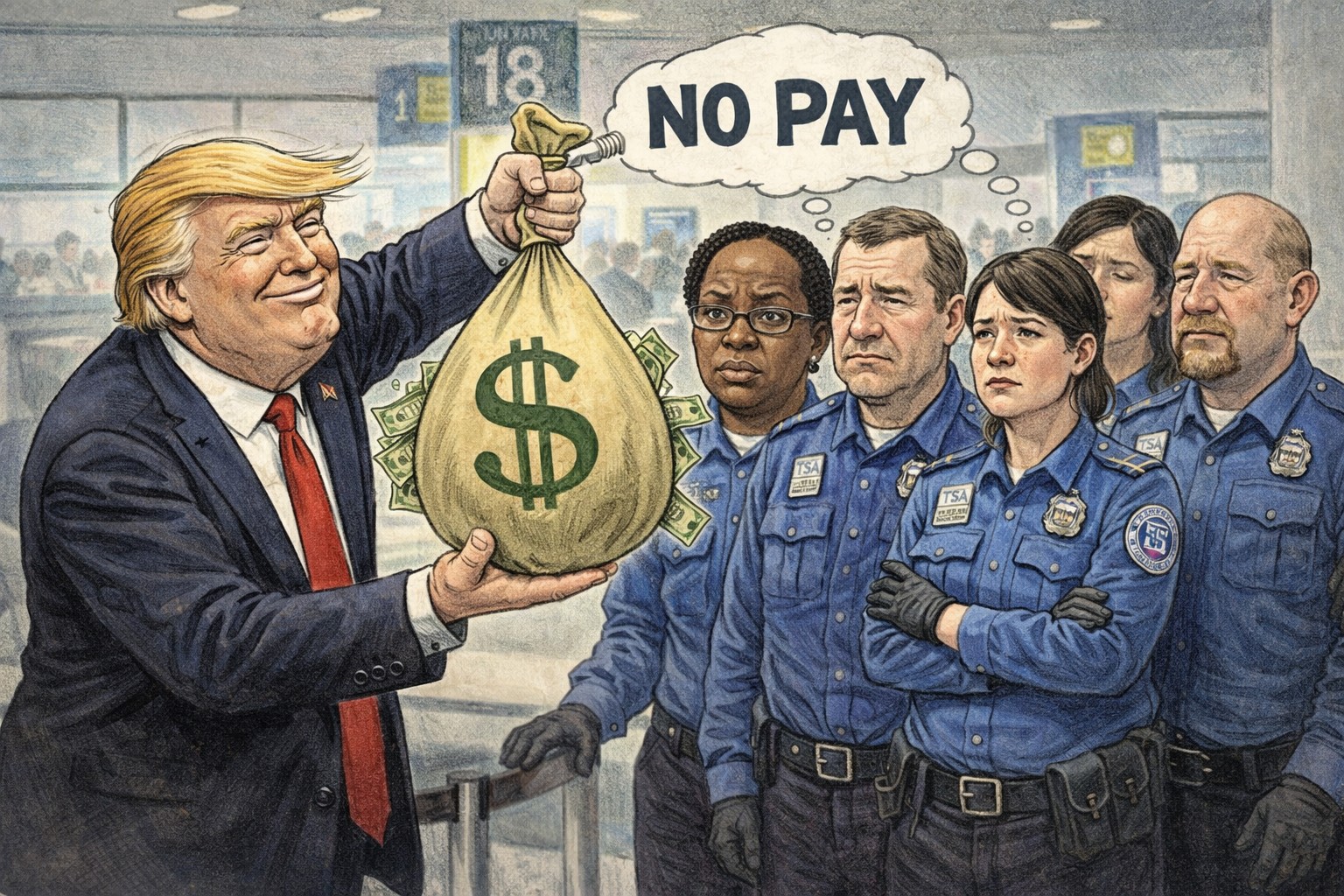
He Could Pay the TSA. He Just Doesn’t Want To.
A president who has bombed a sovereign nation without a congressional vote, demolished a wing of the White House without a permit, and abducted a sitting foreign head of state has absolutely no legal or moral excuse for leaving 60,000 airport security officers without a paycheck. The audacity isn’t incompetence. It’s a choice.
Let us be very clear about what is happening at America’s airports right now. Tens of thousands of Transportation Security Administration officers — the men and women who stand between passengers and the next catastrophic attack on U.S. aviation — are being forced to work without pay. Call-out rates have surged past 11 percent on some days. Hundreds have quit outright. Lines snake through terminals for hours. Checkpoints have closed. And President Donald Trump has deployed ICE agents in tactical gear to “fill the gap” — immigration enforcement officers with virtually no airport security training and where photos demonstrate they are just loitering the airport halls and not assisting at all — while telling the country, in essence: not my problem.
This is a lie of omission so brazen it deserves to be named as such.
President Trump — the same man who ordered B-2 bombers to strike Iranian nuclear facilities without a single congressional vote, who sent special operations forces into Venezuela to abduct a sitting head of state without informing Democratic congressional leaders, who demolished a 123-year-old wing of the White House without the required federal approvals — is now asking Americans to believe that paying TSA workers is simply beyond his reach. That it requires congressional action. That his hands are tied.
They are not.
A president who has spent fourteen months treating the Constitution, federal law, and democratic norms as optional suggestions does not suddenly discover the limits of executive authority when the subject is 60,000 working-class federal employees going without their paychecks. This is a political decision dressed up as a procedural helplessness. And it is an insult to the intelligence of every American standing in those lines.
The funding mechanism is already there. Trump’s own signature legislation — the “One Big Beautiful Bill Act” of 2025 — delivered $75 billion in multi-year, shutdown-proof appropriations for ICE. That is why ICE agents are cashing checks right now while TSA officers cannot. The administration chose, deliberately, to insulate its enforcement priorities with advance funding while leaving airport security workers exposed to every future political standoff. That was not an accident. That was architecture.
What would it take to pay TSA workers? The same presidential will that has been applied, time and again, to actions far more dramatic, far more legally dubious, and far more expensive to the American taxpayer and the American conscience.
To appreciate the absurdity of Trump’s claimed powerlessness over TSA pay, one must look at the full catalog of what this administration has done — what it has been willing to do without congressional approval, without legal cover, without even a press conference warning — when it actually wanted to do it.
And, of course, through all of this, North Dakota’s Congressional delegation – US Rep. Julie Fedorchak (R), US Sen. Kevin Cramer (R), and US Sen. John Hoeven run away in fear from town halls unable to justify their silence nor support policies destroying this state and country. Rome burned while Nero fiddled and America’s democracy and our economy are collapsing while Fedorchak, Cramer, and Hoeven publish their social media photo opportunities.
Here is a brief list of actions Trump has taken that have violated the norms, procedures, and laws of the nation.
THE CATALOG: NORMS, LAWS, AND PROCEDURES TRUMP VIOLATED OR BYPASSED
1. Bombing Iran Without Congressional Authorization
CONGRESSIONAL BYPASS
TAXPAYER FUNDS
CONSTITUTIONAL VIOLATION
On June 21, 2025, Trump ordered B-2 stealth bombers and other aircraft to strike Iranian nuclear facilities in what the Pentagon called “Operation Midnight Hammer,” with no congressional authorization and without notifying Democratic congressional leaders until after U.S. planes had left Iranian airspace — a direct violation of the spirit and letter of the War Powers Resolution. Top Democratic lawmakers from across the intelligence and armed services committees called the strikes unconstitutional. Legal scholars at the Brennan Center described the action as “unaccountable war-making” in direct contradiction to Article I of the Constitution, which vests the power to declare war exclusively in Congress. A subsequent war powers resolution effort failed, largely due to Republican acquiescence. The military operations continued. Then, in late February 2026, Trump ordered a second, broader assault — “Operation Epic Fury” — a “massive and ongoing” air campaign against Iran, again without any congressional debate or authorization. Former military legal experts confirmed the operations trigger the 48-hour written notification requirement to Congress as an institution, not merely a briefing call to select Republican leaders. The strikes have cost billions in taxpayer-funded military assets and placed American service members in harm’s way without democratic authorization.
2. The Abduction of Venezuelan President Nicolás Maduro
CONGRESSIONAL BYPASS
TAXPAYER FUNDS
INTERNATIONAL LAW
On January 3, 2026, U.S. special operations forces attacked the Venezuelan capital of Caracas, bombing military targets and abducting sitting President Nicolás Maduro and his wife from their heavily guarded location — all without congressional notification, much less authorization. The United Nations Secretary-General called the action a “dangerous precedent.” The Venezuelan government, Colombia’s president, Iran, and Cuba all condemned it as an illegal kidnapping of a head of state. Congressional leaders, including Democrats on the intelligence committees, were informed only after the operation was underway. The Trump administration informed only top Republican leaders in advance, breaking longstanding “Gang of Eight” bipartisan norms. Legal experts noted there was no AUMF, no declaration of war, and no imminent threat doctrine that could plausibly justify the operation under U.S. or international law. The operation killed dozens, including Cuban security personnel and Venezuelan military officers. It cost hundreds of millions in taxpayer-funded military deployment.
3. Demolishing the White House East Wing Without Required Approvals
CONSTITUTIONAL VIOLATION
TAXPAYER FUNDS
In October 2025, Trump ordered the demolition of the 123-year-old East Wing of the White House — including the East Garden Room, the Family Theater, and the East Colonnade — to make room for a privately funded $400 million ballroom. The demolition proceeded without submission of plans to the National Capital Planning Commission, without a Section 106 review under the National Historic Preservation Act, without review by the Commission of Fine Arts, and without congressional approval or notification. Legal experts noted violations of the Administrative Procedures Act, the National Environmental Policy Act, and NHPA review requirements. The National Trust for Historic Preservation sued to halt the project. Senate Democrats demanded an accounting of the corporate donors — including Amazon, Apple, Meta, Comcast, and others with active federal regulatory proceedings — raising Antideficiency Act and Emoluments Clause concerns about the pay-to-play dynamics of a $400 million gift to the president’s official residence. The project cost doubled from its initial $200 million estimate and continues to grow.
4. Unilateral Funding Freezes of Congressionally Appropriated Funds
CONGRESSIONAL BYPASS
CONSTITUTIONAL VIOLATION
TAXPAYER FUNDS
In early 2025, the Trump administration issued a sweeping freeze on federal grants and spending, halting disbursement of funds that Congress had already appropriated for programs ranging from electric vehicle charging infrastructure to homelessness services. A federal judge blocked the freeze on February 3, 2025, ruling that Trump “lacked authority to withhold congressionally appropriated funds.” Subsequent rulings by multiple federal judges and the Government Accountability Office found grant terminations and spending freezes to be illegal and unconstitutional. Georgetown Law professor David Super documented how each freeze violated specific statutory mandates requiring the relevant agencies to disburse funds to eligible recipients. The Impoundment Control Act of 1974 — passed specifically to prevent presidents from unilaterally refusing to spend money Congress has allocated — was systematically ignored.
5. Attempt to End Birthright Citizenship by Executive Order
CONSTITUTIONAL VIOLATION
On his first day in office, Trump signed Executive Order 14160 attempting to revoke birthright citizenship for children of undocumented immigrants — a right guaranteed by the 14th Amendment and affirmed by the Supreme Court in U.S. v. Wong Kim Ark (1898). Reagan-appointed Judge John C. Coughenour called the order “blatantly unconstitutional.” Multiple federal judges issued nationwide injunctions. By August 2025, the Supreme Court limited the scope of such universal injunctions, but the underlying constitutional infirmity of the order remains unresolved through the courts. The administration spent substantial taxpayer resources defending an executive order that virtually every constitutional scholar across the political spectrum agrees is facially invalid.
6. Tariffs Imposed Unilaterally, Bypassing Congress
CONGRESSIONAL BYPASS
CONSTITUTIONAL VIOLATION
TAXPAYER FUNDS
Trump invoked emergency economic powers under the International Emergency Economic Powers Act (IEEPA) to impose sweeping tariffs on goods from dozens of countries — tariffs that functionally operate as a tax on American consumers and businesses, a power the Constitution reserves to Congress. Legal challenges have proliferated, with the Supreme Court actively weighing the scope of the administration’s tariff authority. Critics across the legal spectrum argue that using IEEPA as a blanket tariff mechanism vastly exceeds the statute’s scope, which was designed for targeted financial sanctions in genuine national security emergencies, not as a wholesale trade policy tool. The tariffs have cost the U.S. economy hundreds of billions of dollars in disrupted trade, retaliatory measures from trading partners, and elevated consumer prices.
7. The Emoluments Clause and the Ballroom Donors
CONSTITUTIONAL VIOLATION
The Foreign Emoluments Clause prohibits federal officeholders from accepting gifts or benefits from foreign governments without congressional consent. The Domestic Emoluments Clause prohibits presidents from receiving compensation beyond their official salary from any federal or state entity. Throughout both terms, Trump’s continued ownership of his hotels, resorts, and properties — which receive payment from foreign governments, domestic agencies, and corporations with federal regulatory exposure — has generated sustained Emoluments Clause litigation. The White House ballroom project, funded with hundreds of millions in private donations from corporations including those under active DOJ litigation or federal regulatory review, has raised fresh concerns. Senate Democrats have formally demanded accounting of donors. Legal scholars describe the arrangement as presenting a textbook pay-to-play Emoluments problem.
8. Shuttering USAID in Defiance of Congressional Mandate
CONGRESSIONAL BYPASS
CONSTITUTIONAL VIOLATION
TAXPAYER FUNDS
The Trump administration, led by DOGE, moved to effectively dismantle the U.S. Agency for International Development despite Congress having created the agency by statute and appropriated specific funds for programs it administers. Georgetown Law’s David Super noted the paradox bluntly: when Congress has both enacted a statute creating USAID and appropriated funds for its programs, its meaning could not be clearer. The administration proceeded anyway, halting congressionally mandated aid programs, terminating grants, and reassigning or firing career staff — all without congressional authorization to eliminate the agency.
9. Massive Unilateral ICE Expansion at Taxpayer Expense
CONGRESSIONAL BYPASS
TAXPAYER FUNDS
Through the “One Big Beautiful Bill Act,” Trump secured $75 billion in multi-year, shutdown-proof funding for ICE — $45 billion for new detention beds and $30 billion to hire 10,000 new ICE employees. This transformed ICE into effectively the largest federal law enforcement agency in U.S. history, with a budget and workforce insulated from the annual appropriations process that governs nearly every other federal agency. Critics have noted that ICE’s rapid hiring surge proceeded with minimal vetting or training of new officers, even as the agency expanded its operations into airports, schools, churches, and workplaces in ways not contemplated by its original congressional mandate. Revoking TSA workers’ collective bargaining rights in March 2025 — a goal long sought by Project 2025 as a precursor to TSA privatization — was done administratively, without congressional action.
10. Strikes on Venezuela, Nigeria, Caribbean Vessels — Without Authorization
CONGRESSIONAL BYPASS
INTERNATIONAL LAW
TAXPAYER FUNDS
Beyond the Venezuela intervention and Iran strikes, the administration conducted airstrikes on Nigerian territory and ordered more than 34 strikes on vessels in the Caribbean and Eastern Pacific, killing over 110 people, ostensibly as part of counternarcotics operations. No public evidence of drugs was presented for these boat bombings. No congressional authorization was sought. On Christmas Day 2025, U.S. forces bombed targets in Nigeria with virtually no congressional debate. These actions collectively represent the most extensive pattern of unilateral presidential war-making in modern American history, undertaken without any of the statutory frameworks — AUMF, congressional declaration, or War Powers Resolution compliance — that the Constitution requires. Meanwhile, despite justifying the aforementioned bombings as counternarcotics operations, Trump also pardoned former Honduran president Juan Orlando Hernandez, despite him being convicted by a US federal jury and sentenced to 45 years in prison for trafficking 400 tons of US-bound cocaine in exchange for millions of dollars in bribes from drug cartels.
11. Weaponizing the Congressional Review Act Beyond Its Scope
CONGRESSIONAL BYPASS
Working with congressional Republicans, the Trump administration used the Congressional Review Act in 2025 to roll back more agency rules than in every previous year since the CRA’s 1996 enactment — combined. More alarming, Republicans invalidated agency actions that the Senate Parliamentarian, the Government Accountability Office, and legal scholars across the ideological spectrum agreed were not rules subject to the CRA at all, including EPA waivers and Bureau of Land Management resource management plans dating back to 2022. Republicans overrode their own parliamentary referee to do so. Academic analysis found the vast majority of disapproved actions were environmental. The Senate’s defiance of the parliamentarian’s ruling further eroded Senate procedural norms.
12. DOGE Access to Treasury, Mass Federal Firings, and Defying Courts
CONGRESSIONAL BYPASS
CONSTITUTIONAL VIOLATION
TAXPAYER FUNDS
The creation of DOGE — assigned to Elon Musk and granted access to federal payment systems, sensitive databases, and agency operations — was immediately challenged as a violation of the Federal Advisory Committee Act. DOGE’s mass termination of federal employees violated civil service protections and due process requirements. By August 2025, multiple judges and the GAO had found DOGE-directed spending freezes and firings to be illegal. The administration ignored or slow-walked multiple court orders, prompting judges to threaten contempt proceedings. The administration openly telegraphed its posture: OMB Director Russell Vought said in 2024 he didn’t want Trump “having to lose a moment of time having fights in the Oval Office about whether something is legal or doable or moral.” That ethos became policy.
13. Defying the Epstein Files Law and Other Enacted Statutes
CONGRESSIONAL BYPASS
On December 19, 2025 — the legally mandated date for full release of Jeffrey Epstein investigative files — the administration announced it would release only some documents, with the remainder to follow on the administration’s own timeline. Both chambers of Congress had passed the disclosure law; Trump had signed it. The administration simply chose not to comply with its own signature legislation. This episode is not isolated; GovTrack documented a pattern across the administration of selectively complying with enacted statutes when convenient and ignoring them when not.
14. Renaming Department of Defense
CONGRESSIONAL BYPASS
The renaming of the Department of Defense (DoD) to the “Department of War” is considered a violation of federal law if implemented permanently without congressional approval. Only an act of Congress can formally change the statutory name established in 1949. This unauthorized name change will cost taxpayers somewhere between $125 million and up to $2 billion depending on the breadth of changes being made.
14. Renaming the Kennedy Center
CONGRESSIONAL BYPASS
The renaming of the Kennedy Center to the “Trump-Kennedy Center” is considered a violation of law because it bypasses the 1964 congressional act that established the institution, with critics asserting that only Congress has the authority to change its name. The move is the subject of a lawsuit claiming it is an illegal abuse of power, aiming to reverse the renaming and remove the new exterior signage. Reported costs associated with the broader renovation and renaming project are estimated at $257 million.
REPUBLICAN CONGRESS: NO BACKBONE
The cumulative picture is not of an administration straining against its constitutional limits. It is of an administration that has made a studied, strategic choice about which limits to acknowledge and which to discard — and has discovered, repeatedly, that the Republican-controlled Congress lacks the institutional spine to enforce its own authority.
So when Trump administration officials and the Republican members of Congress shrug and say there is nothing to be done about TSA pay without a new appropriations deal, understand what they are really saying. They are saying: we choose not to fix this. We built a system where ICE is insulated and TSA is exposed. We declined the offers that would fund airport security without fully funding immigration enforcement. We are comfortable with the optics of tactical-gear agents staffing security lanes while the actual security professionals go without pay. This arrangement, deliberately designed, serves our political purposes.
The administration has bombed Iran twice. It has sent special forces to abduct the elected president of Venezuela. It has demolished a historic wing of the White House to build a ballroom funded by Amazon and Apple. It has frozen billions in congressionally appropriated funds, defied court orders, dismantled congressionally created agencies, imposed sweeping tariffs without statutory authority, and conducted airstrikes in at least four countries — Nigeria, Venezuela, Iran, and the Caribbean — without a single congressional authorization vote.
But pay the TSA? Impossible. Helpless. Hands tied.
James Madison wrote that the “temptation” to commit the nation to war would be too great for any one man, which is why the founders vested that power in Congress. What Madison did not fully anticipate was a Congress – filled with the likes of Fedorchak, Cramer, and Hoeven – so thoroughly cowed — by party discipline, by political self-interest, by a majority leadership willing to simply look away — that it would hand back that power without a fight. The constitutional machinery to rein in an executive who repeatedly exceeds his authority exists. It requires only political will to operate it. That will has been notably absent.
In the meantime, a TSA officer in Charlotte or Kansas City or Bismarck is standing at a checkpoint, scanning bags, watching for threats — the same threats that once turned commercial aircraft into weapons — and wondering how she will pay her mortgage this month. Not because it is legally impossible to pay her. But because no one with the power to do so has decided it is worth the political cost.
That is not governance. That is cruelty in the guise of procedure. And from an administration that has shown it will break every rule it wishes to break when it wishes to break it, the excuse wears thinner by the day.
Pay the TSA. You know how. You’ve done harder things before breakfast.