



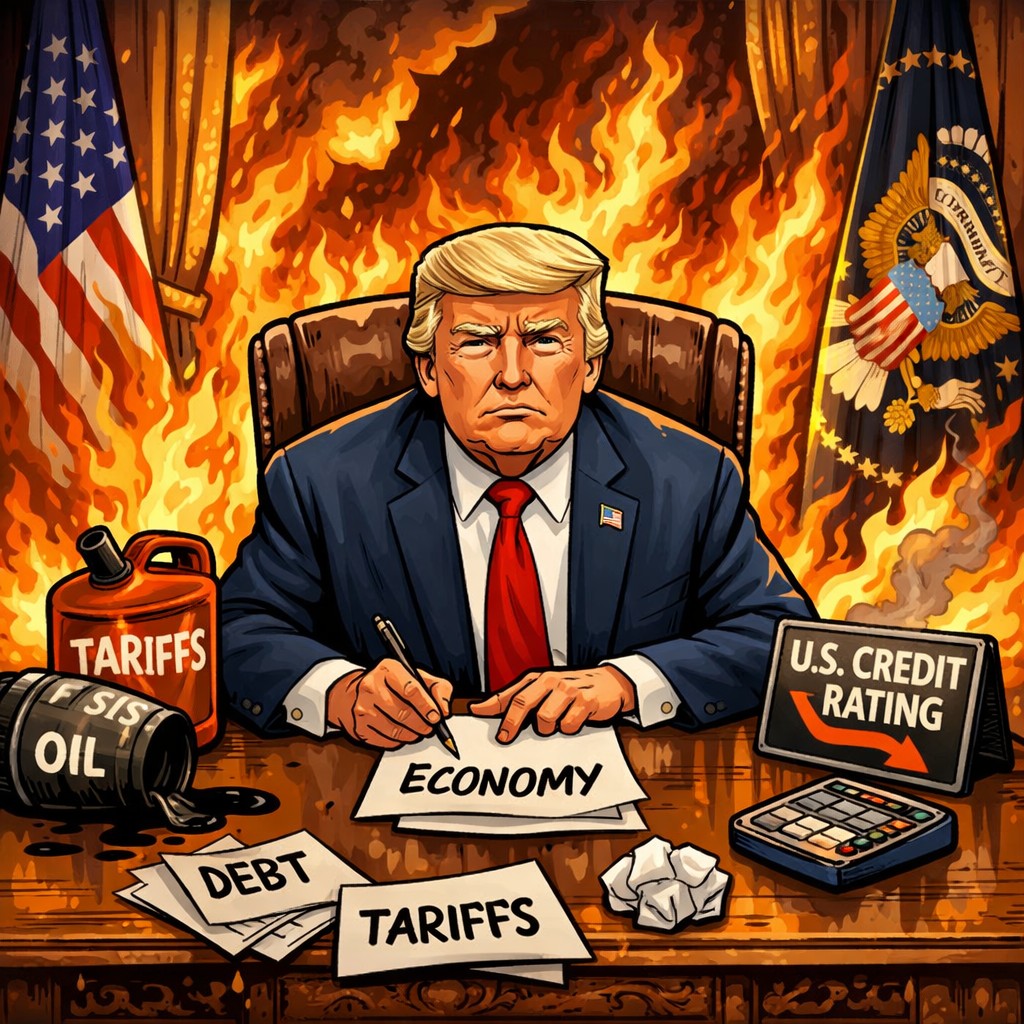
Who could have predicted that a 6-time business bankrupting person – including bankrupting casinos where “the house always wins” – would drive the US economy into the dirt?
Well, practically everyone – but especially some of the most respected world economists who forecasted that President Donald Trump’s second-term policies—primarily centered on aggressive tariffs and mass deportations—would lead to higher inflation, slower economic growth, and a wider national debt. While some analysts anticipated short-term benefits from tax cuts and deregulation, many cautioned that these would be more than offset by the negative impacts of trade barriers and a shrinking labor supply.
The Cost of Policy: Quantifying Economic Damage in Trump’s Second Term
When Donald Trump returned to the White House in January 2025, he inherited an economy characterized by moderating inflation, steady growth, and relatively low unemployment. Fifteen months into his second term, the economic picture has become far more more costly.
This analysis compiles the most credible available data to identify key economic harms and estimate their dollar-scale impact across major sectors of the U.S. economy.
1. Credit Rating Downgrade & Borrowing Costs
One of the clearest signals of economic deterioration came in May 2025, when Moody’s downgraded U.S. sovereign debt, stripping the country of its last AAA rating – the first time in history for the United States to lose it – meaning because of the country’s increased credit risk, the interest rate on the cost of the American government’s borrowing goes up. (The Wall Street Journal)
Estimated cost:
- Treasury yields rose toward ~5% on long-term bonds after the downgrade (Business Insider)
- On ~$34–39 trillion national debt, even a 0.5% increase in borrowing costs implies:
👉 $170–$195 billion per year in additional interest payments
10-year impact: ~$1.7–$2 trillion
This is one of the largest quantifiable economic consequences, as it compounds annually.
2. Tariffs: Direct Costs to Consumers, Businesses, and Farmers
Trump’s signature policy—broad tariffs (including a 10% universal tariff)—has had widespread effects.
Who pays?
- 94–96% of tariff costs are borne domestically (consumers + businesses) (Wikipedia)
Quantifiable impacts:
- Tariffs increase inflation by ~0.4 percentage points annually (New York Post)
- Reduce GDP growth slightly each year (~0.06%) (New York Post)
Dollar estimate:
- U.S. GDP ≈ $30 trillion
- 0.06% annual drag = ~$18 billion/year lost output
Consumer cost:
- If tariffs effectively function as a tax on imports (~$3 trillion imports annually), a 10% tariff =
👉 ~$300 billion/year gross cost - Adjusting for partial offsets and behavioral changes:
👉 Estimated net cost: $150–$250 billion/year to U.S. consumers & firms
Agriculture losses:
- Retaliatory tariffs reduced exports (e.g., soybean exports collapsing in some markets) (Wikipedia)
- Federal bailouts partially offset losses
👉 Estimated farm-sector disruption: $20–$40 billion/year
3. Inflation & Cost of Living
Inflation has remained above the Federal Reserve’s 2% target and is projected to rise further.
- OECD projects U.S. inflation up to 4.2% in 2026 under current conditions (New York Post)
- Food prices up ~2.9%, utilities over 6% (The Guardian)
Household impact:
- U.S. consumer spending ≈ $18 trillion/year
- A sustained 1–2% excess inflation =
👉 $180–$360 billion/year loss in purchasing power
This acts as a broad “hidden tax” on households.
4. Oil Prices & Gasoline Costs
Rising geopolitical tensions – namely the war in Iran instituted by Trump – and resulting supply disruptions have pushed energy prices upward.
- Reports cite rising gasoline prices and economic uncertainty in early 2026 (PBS)
- Oil shocks tied to Middle East tensions are driving inflation higher (New York Post)
Estimated cost:
- U.S. consumes ~140 billion gallons of gasoline annually
- A $0.50/gallon increase =
👉 ~$70 billion/year added cost to consumers
5. Stock Market & Wealth Effects
Tariff escalation triggered a stock market correction and crash episodes in 2025 (Wikipedia)
Estimated wealth impact:
- U.S. equity markets ≈ $50 trillion
- A 10% correction =
👉 ~$5 trillion in lost market value (temporary but impactful)
Even partial losses reduce retirement savings and consumer confidence.
6. Slowing Growth & Labor Market Weakness
- GDP growth slowed and even briefly turned negative (-0.5% early 2025) (Wikipedia)
- Job growth weakened and unemployment ticked up (Wikipedia)
- Risk of stagflation (inflation + unemployment) identified by economists (SIEPR)
Estimated cost:
- If growth slows by ~1 percentage point relative to potential:
👉 ~$300 billion/year in lost economic output
7. Rising Debt & Deficits
- Federal deficit projected at $1.9 trillion in 2026 (Congressional Budget Office)
- Long-term deficits widening
Combined with higher interest rates, this compounds fiscal strain.
8. “Insolvency” Claims & Fiscal Instability
Some commentary has framed U.S. finances as approaching insolvency risk due to:
- Rising debt (~$39 trillion range cited in reporting) (Fortune)
- Increasing borrowing costs
- Structural deficits
While the U.S. is not formally insolvent in a legal sense, market signals (downgrades, yields, dollar pressure) reflect declining confidence.
Total Estimated Annual Economic Cost
| Category | Estimated Annual Cost |
|---|---|
| Higher borrowing costs | $170–$195B |
| Tariffs (net domestic burden) | $150–$250B |
| Inflation (excess) | $180–$360B |
| Energy costs | ~$70B |
| Slower growth | ~$300B |
| Agriculture losses | $20–$40B |
| Total (annual) | ~$890B – $1.2T per year |
Conclusion: A High-Cost Economic Experiment
The defining economic feature of Trump’s second term has been a shift toward protectionism, fiscal expansion, and political intervention in markets. While some policies—such as tariffs—have generated federal revenue and modest short-term gains, the broader data suggest substantial offsetting costs.
The downgrade of U.S. creditworthiness, rising inflation, weakened consumer purchasing power, and global trade disruptions together amount to a roughly $1 trillion annual drag on the U.S. economy—a figure comparable to the size of entire national economies.
Perhaps most significantly, many of these costs are structural rather than temporary. Higher borrowing costs, diminished global confidence, and trade fragmentation could continue to weigh on the U.S. economy long after current policies change.
In economic terms, the second Trump presidency is shaping up not as a single shock—but as a compounding one.