



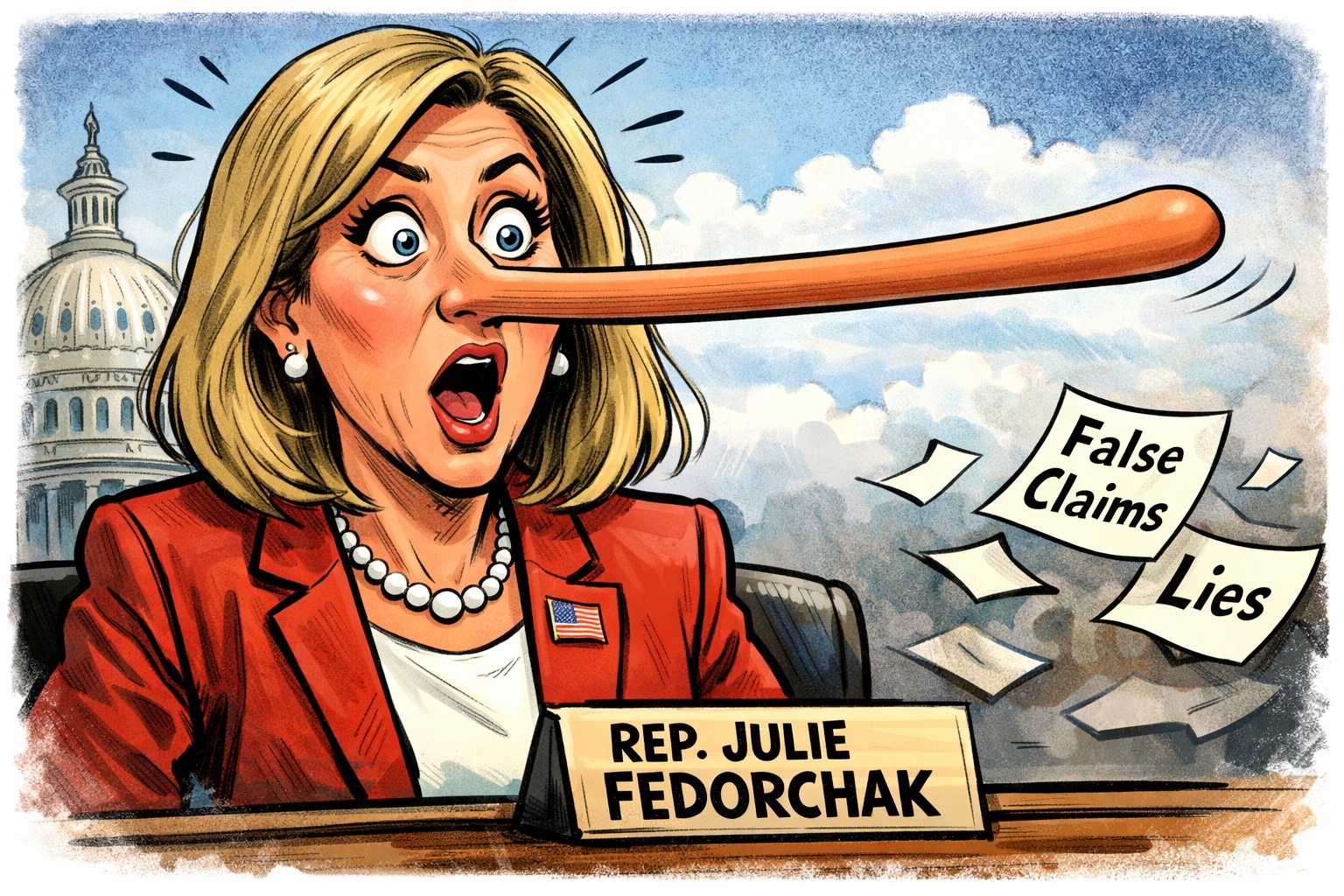
When a political candidate has to repeatedly rely on false and misleading claims, you can stop believing any claims they make.
US Rep. Julie Fedorchak has met that threshold time and time again, but here we go again – addressing false and misleading claims recently disseminated in one of her emails sent out this week.
To assess the accuracy of Fedorchak’s claims, it’s necessary to compare each assertion with findings from oversight agencies such as the U.S. Department of Health and Human Services Office of Inspector General (OIG), the Government Accountability Office (GAO), and the Congressional Budget Office (CBO), along with documented audits and reports.
Claim 1:
“HHS found that nearly $289 million in Medicaid payments were made on behalf of deceased individuals. In one sample, 99 out of 100 payments were issued for individuals who had already died.”
Assessment: Misleading, based on real but mischaracterized findings.
Federal watchdogs—including the HHS OIG—have indeed identified improper Medicaid payments involving deceased individuals. Audits have found cases where states failed to promptly remove beneficiaries from eligibility systems after death, leading to payments that should not have been made.
However, the $289 million figure appears to come from aggregated or extrapolated audit findings, not a single confirmed loss total across the entire program. Oversight reports typically examine limited samples and project possible nationwide impacts, which introduces uncertainty.
The claim that “99 out of 100 payments” in a sample went to deceased individuals is especially misleading. While some audits have found high error rates within narrowly defined samples (for example, cases already flagged as suspicious), those samples are not representative of all Medicaid payments. Presenting such a statistic without context exaggerates the scale of the issue.
Bottom line: Improper payments tied to deceased individuals do occur and are a known oversight issue, but the claim inflates both the scale and certainty of the findings.
Claim 2:
“Federal agencies have also identified 2.8 million duplicative enrollees across Medicaid and Affordable Care Act exchange plans.”
Assessment: Partially accurate, but lacking critical context.
The GAO and HHS OIG have reported instances of “dual enrollment”, where individuals are enrolled in both Medicaid and Affordable Care Act (ACA) marketplace plans at the same time. These situations can occur due to data-sharing delays, income fluctuations, or administrative lag, not necessarily fraud.
Estimates in the millions have been cited in oversight discussions, particularly during periods of rapid enrollment growth under the Affordable Care Act. However, these figures generally refer to potential or temporary overlaps, not confirmed cases of improper payments or intentional duplication.
In many cases, dual enrollment is short-lived and corrected automatically, and not all overlaps result in the government paying twice for coverage.
Bottom line: Dual enrollment has been identified and can reach large numbers in raw counts, but the claim overstates its significance by implying widespread fraud or sustained duplicate payments.
Claim 3:
“The Congressional Budget Office (CBO) found that Democrat policies have led to at least 2.3 million fraudulent enrollees in Obamacare.”
Assessment: False.
There is no evidence that the CBO has made such a finding. The CBO, a nonpartisan analytical body, evaluates costs, coverage levels, and budget impacts, but it does not attribute fraud levels to specific political parties or policies in this manner.
While the CBO has estimated enrollment levels and discussed uncertainties in ACA projections, it has not reported “2.3 million fraudulent enrollees”, nor has it framed its analyses in partisan terms.
Bottom line: This claim is unsupported and misattributes conclusions to the CBO that it has not made.
Claim 4:
“Federal investigators created fake applicants that were repeatedly approved for Affordable Care Act marketplace plans. Applicants were repeatedly enrolled with no identification or fake ID documents.”
Assessment: Partially accurate, but missing key limitations.
This claim is grounded in documented investigations by the GAO. In undercover testing, federal investigators created fictitious applicants and were initially approved to obtain ACA marketplace coverage in some cases.
However, these findings came from controlled tests designed to probe and correct vulnerabilities, not from real-world enrollment at scale. The GAO’s work demonstrated weaknesses in verification systems, particularly in earlier years of ACA implementation, but it did not conclude that such enrollments were widespread or persistent across the entire system. This is normal stress testing of any program – often found in the banking industry with “vulnerability testing.”
Importantly, many of these vulnerabilities have since been addressed through enhanced identity verification and data-matching systems.
Bottom line: The claim is based on real investigative findings, but it overgeneralizes limited test results into a broader narrative about the system as a whole.
The Bigger Picture
Federal health programs like Medicaid and ACA marketplaces are vast, covering tens of millions of Americans and involving hundreds of billions in annual spending. Oversight agencies consistently find improper payments, administrative errors, and system vulnerabilities, but they also emphasize that:
- Most enrollees are legitimate
- Many errors stem from complexity, not fraud
- Safeguards have improved over time
What emerges from reviewing these claims is a pattern: real findings are often stripped of context, scaled up, or reframed in ways that suggest broader systemic failure than the evidence supports.
The math, in many cases, does not support the rhetoric—but the underlying oversight concerns remain real and continue to be the focus of ongoing federal audits and reforms.