



War With Iran Exposes a Stark American Contradiction: Billions for Bombs, Cuts for the Poor
March 16, 2026
As American warplanes continue pounding targets across Iran and the bills for Operation Epic Fury mount by the billions, a deeply uncomfortable question is echoing through congressional hallways and kitchen tables alike: How did a nation that just forced through a very unpopular slashing of food stamps, Medicaid, and public housing – to fund even MORE tax breaks for billionaires – find nearly $1 billion a day to wage a new Middle East war — and why, exactly, are we fighting it?
- Tough economy for your family? Too bad.
- Trump’s tariffs costing taxpayers and additional $2,000 more per year in higher prices from the tariffs? Tough luck.
- DOGE federal employee layoffs impacting your federal parks, your VA service, or quality of education? Who cares.
- Cost of healthcare tripling or quadrupling from the elimination of the ACA? Sounds like a you problem.
- Masked ICE agents snatching citizens, lawful residents, and employed, lawful undocumented persons from homes, workplaces, and anywhere else – and no due process while they hold you 6 months or longer in a Trump-endorsed gulag on US soil – or ship you off to the CECOT in El Salvador where you’re held with dozens of others in a single mass holding well and held indefinitely while US taxpayers pay El Salvador – giving El Salvador no reason to process those arrested and lose US funding? What’s a US constitution violation here and there …
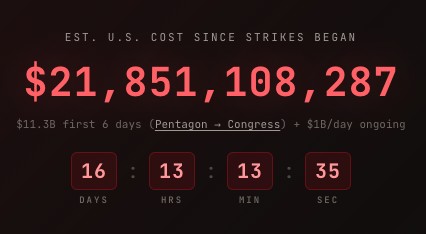
To get an up-to-the-second cost to taxpayers of this debacle being led and supported by the GOP – including U.S. Rep. Julie Fedorchak, U.S. Sen. Kevin Cramer, and U.S. Sen. John Hoeven, – click here for the Trump/GOP Iran War Cost Tracker – showing a staggering cost to taxpayers of nearly $22 billion just 6 days into the incursion as of 12:30 pm on Monday, March 16.
How the War Began — and the Shifting Story
On February 28, 2026, the United States and Israel launched a surprise joint military operation that assassinated Iran’s Supreme Leader Ali Khamenei, killed other Iranian officials and civilians, and damaged military bases, government facilities, schools, hospitals, and cultural heritage sites.
Although technically not a war because a declaration by Congress is needed for a military action to be classified as war – Trump himself has called the conflict a war on multiple occasions despite the conflict not have Congressional approval, in addition to Trump calling it an “excursion”, which is actually a “quick, leisurely vacation”. But it is not unusual for Trump to demonstrate a small vocabulary, use the incorrect word, or latch onto a new, simple word (remember, “groceries”?).
The justifications offered by the Trump administration have been anything but consistent. Administration officials have offered various and conflicting explanations for the attack, including:
- Excuse 1: To ward off an imminent Iranian threat
- Excuse 2: To pre-empt Iranian retaliation against U.S. assets after an expected Israeli attack
- Excuse 3: To destroy Iran’s missile and military capabilities
- Excuse 4: To prevent Iran from obtaining a nuclear weapon; even though Trump had declared the US had completely and totally obliterated Iran’s nuclear capability from an attack he orchestrated several months earlier
- Excuse 5: To secure Iran’s natural resources
- Excuse 6: To achieve regime change by bringing the Iranian opposition to power
The stated rationale shifted even in the weeks before the strikes. On January 2, Trump threatened “lock and loaded” military intervention if Iran killed peaceful protesters even though the Trump Administration’s ICE program has been responsible for multiple deaths of peaceful protestors across the United States and he has instructed the Department of Justice to prosecute, jail, and hold peaceful American protestors as terrorists for up to 15 years. On January 13, he expressed support for Iranian anti-government demonstrators and pledged “help is on the way.” By the time Trump addressed the nation on February 28, the framing had changed again. He said the United States launched strikes to “defend the American people by eliminating imminent threats from the Iranian regime” and reiterated that Tehran “can never have a nuclear weapon.”
Yet that imminent-threat rationale was undercut almost immediately. The Trump administration did not provide any evidence that Iran was planning to preemptively strike U.S. assets, and an unspecified Pentagon source told Congress in closed-door briefings that there was no intelligence suggesting Iran was planning to attack U.S. forces first.
Further, GOP congressman Sen. Lindsey Graham, Georgia, a closely ally of Trump, open stated, “We’re going to make a ton of money”, suggesting the attack was actually done to gain control over its oil supplies, much like what happened when Trump ordered the kidnapping of Venezuelan president Nicolas Maduro under the guise of his alleged involvement in drug running, but then shortly thereafter Trump coordinating with oil executives to take over the country’s oil and setting up an account in Qatar to hold the funds from the sale of the oil, bypassing the US Treasury.
Meanwhile, nuclear talks between the two countries had been progressing. Iran’s foreign minister stated that a “historic” agreement was “within reach” just days before the strikes began. According to Oman’s lead mediator, negotiations over the nuclear program had been making progress and continued right up until the attacks, which he characterized as solely an attempt to reorder the Middle East in Israel’s favor.
The Cost: Billions Per Week
The financial toll is staggering and growing. Pentagon officials told senators in a closed-door briefing that they estimate the first six days of the war cost more than $11.3 billion. One senator said he believes the cost is even higher, since the figure did not include every aspect of the war.
By the 12-day mark, the Center for Strategic and International Studies estimated U.S. spending at approximately $16.5 billion. Think tanks and defense analysts estimate the war is costing roughly $891 million per day, and the Penn Wharton Budget Model projects the total could ultimately reach between $40 billion and $95 billion — with broader economic impacts potentially reaching $210 billion.
CNN’s Lindsay Koshgarian of the National Priorities Project put it bluntly: “The cost of the war in Iraq ended up being almost $3 trillion. So this could be astronomical, easily.”
The human cost is also rising. At least 13 U.S. service members have been killed, including 7 by enemy fire. More than 2,000 people have been killed in Iran, Lebanon, and Israel combined, with 773 deaths in Lebanon alone and over 830,000 people displaced.
A Reuters/Ipsos poll showed dismal public approval for the war, with 56% of Americans opposing it, and even more opposing the impact it is having to the price of fuel at the pump. Also, American memories recall the hundreds of times Trump and his advocates promised no more wars, especially in the Middle East, leading up to Trump’s 2024 election.
The Bitter Contrast: What Was Cut at Home
The war’s expense lands with particular weight because it comes on the heels of sweeping domestic cuts engineered through both Elon Musk’s Department of Government Efficiency and the One Big Beautiful Bill Act, which President Trump signed into law on July 4, 2025.
The One Big Beautiful Bill cuts $1.7 trillion, mostly in domestic spending, while providing the top 5 percent of taxpayers with roughly $1.5 trillion in tax breaks.
The programs hit hardest include:
SNAP (Food Stamps): The law cuts $187 billion in federal SNAP funding — roughly 20% — the largest cut to the program in its history. The Congressional Budget Office estimates that approximately 4 million people will lose benefits, and by 2034, the average SNAP benefit will be $14 per month less than it would have been without the cut. More than 300,000 veterans, people experiencing homelessness, and young people aging out of foster care lose SNAP benefits because the law removed exemptions for these groups.
Medicaid: The bill makes a 15% cut to Medicaid spending. Combined with the expiration of ACA premium subsidies, the Congressional Budget Office estimates the total number of uninsured Americans will rise by 17 million people by 2034.
Veterans’ Services: The Veterans Administration is on the block for deep cuts, including possible layoffs of up to 80,000 employees — a move that would slow the processing of benefits for those who served in America’s past wars. About 1.2 million veterans live in households that receive food assistance through SNAP, and 56,000 families with veterans would lose an average of $219 a month in food assistance.
USAID and Public Broadcasting: The U.S. Agency for International Development, the Corporation for Public Broadcasting, and much of the Education Department have been effectively eliminated through DOGE-driven cuts.
Housing for the Homeless: Leaked HUD documents reveal plans to severely cap funding for permanent supportive housing, a move HUD itself estimates would strip over 170,000 formerly homeless people of their housing assistance.
Consumer Financial Protections: The bill significantly slashed the Consumer Financial Protection Bureau’s budget, including its Office of Servicemember Affairs, which is tasked with protecting military families from financial fraud and predatory lending.
The Bottom Line
House Minority Leader Hakeem Jeffries put the tension plainly: Trump is “spending billions of dollars to bomb Iran,” he told reporters, but “can’t find a dime to make it more affordable for the American people to go see a doctor.” He said Congress can’t find money to help Americans buy a home or lower grocery bills — yet the Pentagon is burning through a billion dollars a day in the skies over Tehran.
As the Institute for Policy Studies noted, the Pentagon is spending massively for an unauthorized war of choice while Americans struggle to afford basic necessities — and Congress has yet to pass a supplemental spending bill or formally authorize the conflict.
The war is ongoing. The bills are unpaid. And the justifications keep changing.