




While Republicans work hard to demonize socialism, their GOP donors rake in billions in government subsidies. This article explains how America’s richest corporations cash government checks at the front door — and then send their low wage, hungry workers to the welfare line out back.
But as long as Republicans have you focused obsessively on an individual collecting $200 in food assistance, they know they can keep you distracted as a corporation collects $200 million in tax abatements down the street.
This is the story of the double dip. And the numbers are staggering.
The Double Dip
The United States spends a great deal of breath denouncing “welfare dependency.” Politicians rail against it. Talk show hosts make careers off it. And every year, the federal government launches another round of audits on individuals pocketing an extra hundred dollars in food assistance they weren’t entitled to. Meanwhile, behind polished marble lobbies and through the fine print of the U.S. Tax Code, some of the wealthiest corporations on earth are quietly collecting hundreds of billions of dollars from the same government that frets over those food stamps — and paying their workers so little that those workers head straight for the nearest welfare office after their shift ends.
PART ONE: THE SUBSIDY KINGS
The nonprofit watchdog Good Jobs First has been tracking government subsidies to corporations for over two decades. Their database, covering state, local, and federal handouts through tax credits, grants, abatements, and training reimbursements, tells a story that rarely makes the front page.
At the top of the corporate welfare leaderboard sits Boeing, which has collected nearly $16 billion in government subsidies since 2000, the bulk of it from Washington State, which maintains nine preferential tax rates for the aerospace industry. This is a company with an assembly plant in Everett, Washington that is reportedly the largest manufacturing facility on Earth by volume — and it still receives government handouts rivaling the annual budget of many mid-sized nations.
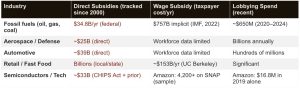
But Boeing is merely the headliner. The top twenty subsidized industries in America — spanning energy, automotive, aerospace, technology, retail, chemicals, and finance — have together received over $250 billion in disclosed subsidies since the turn of the millennium.
Intel comes in second on the direct subsidy list, having received over $8.4 billion since 2000. The Biden Administration added another $7.9 billion through the CHIPS and Science Act. The automotive sector collectively rakes in an estimated $39 billion in tracked subsidies, with Ford (~$8B) and General Motors (~$7.8B) leading the pack. Tesla, meanwhile, has reaped nearly $9 billion since 2018 through sales of regulatory credits alone — government-created instruments that other automakers must purchase to comply with emissions rules — while also collecting billions more in direct state and federal benefits.
The most striking individual case may be Elon Musk. A Washington Post analysis found that Musk’s companies — including Tesla, SpaceX, and others — have received at least $38 billion in government contracts, loans, subsidies, and tax credits over the past two decades. In 2024 alone, $6.3 billion in new public funds were committed to his ventures, a record year. The true total is almost certainly an undercount, since classified defense contracts are excluded. This is the same Musk who, while heading up the so-called Department of Government Efficiency and calling for sweeping cuts to public services, once wrote on social media: “Take away the subsidies.”
Amazon has received an estimated $11.6 billion in subsidies from state and local governments since 2000 — including over $4.3 billion for a single data center project in Indiana. As watchdogs have noted, Amazon’s total subsidy haul is almost certainly an undercount, because so many deals are never made public.
THE FOSSIL FUEL GOLD RUSH: Trump BBB adds $4 billion in oil subsidies
No sector harvests government money with more consistency — or more political muscle — than the fossil fuel industry. Oil, gas, and coal companies have spent nearly $650 million lobbying Congress in the five-year period from 2020 to 2024.
A 2025 report from Oil Change International calculated that the federal government now hands the fossil fuel industry an estimated $34.8 billion annually. That figure jumped sharply after the passage of Trump’s “One Big Beautiful Bill Act,” which added over $4 billion per year in new subsidies, on top of $30.8 billion in preexisting annual handouts.
And that’s just the direct subsidies. When economists factor in so-called “implicit” subsidies — the uncompensated costs of pollution, health impacts, and climate damage that society absorbs so oil companies don’t have to — the numbers become almost incomprehensible. The International Monetary Fund estimated that in 2022, total fossil fuel subsidies in the United States reached $757 billion in a single year. Globally, the IMF put the number at over $7 trillion.
PART TWO: THE WAGE SUBSIDY NOBODY TALKS ABOUT
If the direct corporate subsidies constitute the front door of the double dip, the wage subsidy is the back door — less visible, more insidious, and arguably more morally troubling.
In 2020, Congress’s nonpartisan Government Accountability Office released a landmark study, commissioned by Sen. Bernie Sanders, that asked a simple question: where do the people on food stamps and Medicaid work? The answer was a scandal hiding in plain sight.
The GAO analyzed data from 15 agencies across 11 states. The finding: millions of full-time workers — the majority of them adults working 50 or more weeks per year — earn wages so low they qualify for federal food and health assistance. Approximately 70% of recipients studied worked full-time. This is not a story about people who chose welfare over work. This is a story about working people who cannot survive on what they are paid.
And the companies at the top of that list? Walmart and McDonald’s — two of the most profitable corporations in American history.
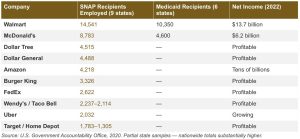
These are partial figures. Researchers at the University of California, Berkeley estimated the nationwide cost of public assistance to low-wage corporate workers at over $150 billion per year. Walmart alone, according to a report by Americans for Tax Fairness, costs taxpayers an estimated $6.2 billion annually in food stamps, Medicaid, and subsidized housing for its workforce.
““At a time when corporations like Walmart and McDonald’s are making billions in profits… they’re relying on corporate welfare from the federal government by paying their workers starvation wages. That is morally obscene.”” — Sen. Bernie Sanders (I-VT), 2020
The living wage in the United States — the income level at which a single adult can afford life’s basic necessities — reached $25.02 per hour in 2024. The federal minimum wage has remained frozen at $7.25 per hour for over a decade and a half. The gap between those two numbers is a subsidy — paid not by corporations, but by taxpayers.
THE PERFECT MACHINE
Taken together, these two stories describe something more coherent than mere hypocrisy. They describe a system — one that transfers money upward with remarkable efficiency. Large corporations receive billions in direct government subsidies to reduce their costs and increase their profits. They simultaneously pay wages below subsistence level, offloading the cost of maintaining their own workforce onto federal assistance programs. They then deploy a fraction of their profits lobbying the same government to keep both arrangements intact.
The economic term for what corporations like Walmart and McDonald’s do with their workers’ wages is “externalize costs.” The political term, dating at least to the 1960s, is blunter: “socialism for the rich, capitalism for the poor.” After the 2008 financial crisis, when banks socialized their losses and privatized their profits, the phrase briefly went mainstream. Then it faded again.
A 2025 analysis from the Institute on Taxation and Economic Policy revealed that four companies whose CEOs stood flanking President Trump at his 2025 inauguration — Amazon, Alphabet, Meta, and Tesla — collectively reported $315 billion in U.S. profits that year and collectively paid an effective federal tax rate of just 4.9 percent. Tesla paid exactly zero. Combined, the four companies collected $51 billion in federal tax breaks in a single year.
““In 1960s America, the issue was known as ‘socialism for the rich, capitalism for the poor.’ After 2008, it became ‘privatizing profits and socializing losses.’ The names change. The mechanism doesn’t.”” — 247 Wall St., 2024
WHAT’S THE DEFENSE?
The corporations on these lists are not silent. Their responses follow a familiar script. Walmart says it removes “employment barriers” for people who would otherwise struggle to find work. McDonald’s argues that wage data is misleading. The fossil fuel industry insists its subsidies represent strategic national security investments. Boeing points to the hundreds of thousands of aerospace jobs it sustains. Tesla says the regulatory credit system is exactly how policy should work — incentivizing clean technology through market mechanisms.
There is something to each defense. Energy policy is genuinely complex. Economic development incentives do sometimes create jobs that wouldn’t otherwise exist. A semiconductor factory in Arizona, even a subsidized one, is better than no semiconductor factory at all if the alternative is dependence on foreign supply chains. These are real policy trade-offs, and reasonable people disagree about the line between smart industrial policy and cronyism.
But the wage subsidy story has no equivalent defense. When a company with $13.7 billion in annual profit pays its workforce below the poverty line and allows the federal government to make up the difference, there is no strategic rationale. There is only a transfer — from taxpayers to shareholders — dressed up as employment.
THE BOTTOM LINE
The United States spends roughly $700 billion per year on national defense. It spends hundreds of billions more subsidizing corporations through tax credits, grants, regulatory credits, cheap public land access, and the direct cost of maintaining below-poverty workforces. Much of this flows to companies that are already profitable — companies that lobby aggressively to keep the arrangement in place and fund campaigns of politicians who call for cutting Medicaid, food stamps, and public housing.
It is not that corporate subsidies are always wrong. It is that the conversation about government assistance in this country has been deliberately, systematically distorted — focused obsessively on the individual collecting $200 in food assistance while largely ignoring the corporation collecting $200 million in tax abatements down the street.