



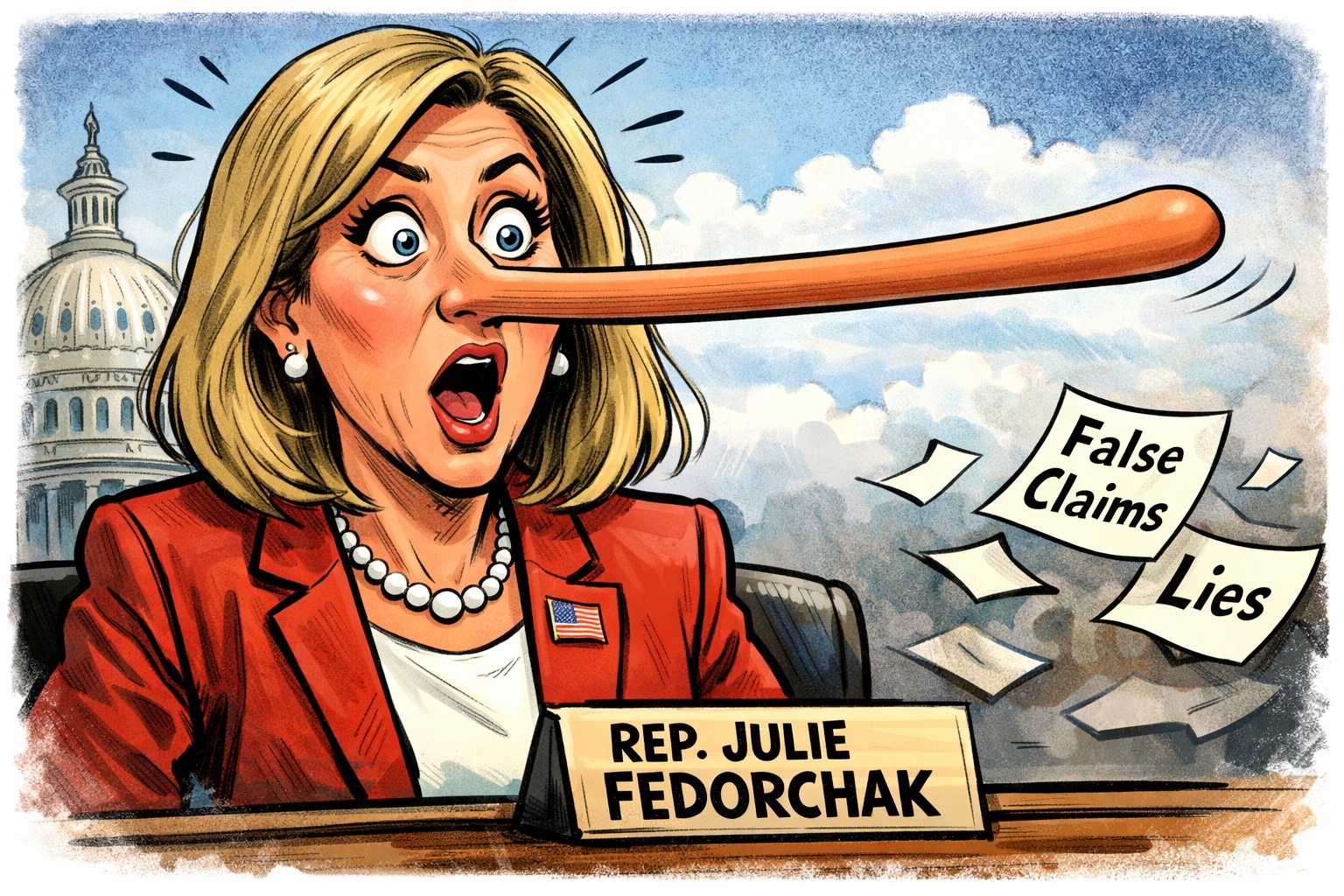
North Dakota’s U.S. Rep. Julie Fedorchak is out of the gate in March with a campaign commercial making three claims, each claim earning a Pinnochio.
In the commercial, Fedorchak features one actor who says, “No taxes on my overtime,” while another actor says, “No taxes on my social security,” and a third actor who claims, “That’s $2,000 in savings for families like mine.”
Fedorchak is making those claims, which were part of the so-called “One Big Beautiful Bill Act” (OBBBA) – the bill that has permanent tax cuts for billionaires and huge funding cuts to much needed social programs, signed into law on July 4, 2025.
Here’s a breakdown of each claim:
1. “No Tax on Overtime”
Fedorchak Claim: No taxes on my overtime.
Verdict: FALSE
What it actually is: A deduction, not an elimination of taxes. It’s also limited to certain workers and it expires in 2028, unlike the permanent tax cuts passed in the bill for Fedorchak and Trump’s billionaire friends who will receive $4-$5.5 trillion in tax cuts over the next 10 years.
The phrase “no tax on overtime” describes a new tax deduction for qualified overtime compensation, not a full tax elimination. Eligible workers can deduct up to $12,500 of overtime pay per year (or $25,000 for married couples filing jointly).
Key stipulations:
- It applies only to the “half” portion of time-and-a-half overtime pay that is required by the Fair Labor Standards Act (FLSA), not the full overtime amount.
- It applies only to W-2 employees — independent contractors and gig workers are not eligible.
- The deduction phases out — potentially to zero — if your modified adjusted gross income exceeds $150,000 (or $300,000 for joint filers).
- It is temporary — only applying for the 2025 through 2028 tax years.
- Overtime pay is still subject to Social Security and Medicare (FICA) taxes on the full amount — those are not affected by this deduction.
- Exempt salaried workers (executives, lawyers, doctors, engineers, etc.) who are not entitled to overtime under FLSA do not qualify.
2. “No Tax on Social Security”
Fedorchak Claim: No taxes on my social security.
Verdict: FALSE
What it actually is: An additional temporary standard deduction for seniors — not an elimination of Social Security taxes, unlike the permanent tax cut for the billionaires.
Trump’s original 2024 campaign promise was to eliminate all income taxes on Social Security. The One Big Beautiful Bill Act does not include that provision. Instead, it provides a new additional standard deduction of $6,000 per individual (ages 65+), temporarily available from 2025 through 2028.
Key stipulations:
- The $6,000 deduction is per eligible individual — so $12,000 total for a married couple where both spouses qualify. It is available to both itemizers and non-itemizers.
- The deduction phases out at a 6% rate for single taxpayers earning more than $75,000 and married taxpayers earning more than $150,000, and phases out entirely at $175,000 (single) and $250,000 (married).
- Social Security recipients younger than 65 — including people on disability or those who claimed benefits early — do not qualify.
- The deduction lowers taxable income for all income, not specifically Social Security. People already making less than the standard deduction get no additional benefit since their tax liability is already zero.
- The Tax Policy Center estimates that about half of all Social Security recipients will still pay at least some income taxes on their benefits, contrary to the “90% pay no tax” claim made by the White House.
- Critics also note this provision would accelerate Social Security insolvency, with the Committee for a Responsible Federal Budget estimating it could push the program into insolvency in 2032 rather than 2033.
3. The “$2,000 in Savings” Claim
Fedorchak Claim: That’s $2,000 in savings.
Verdict: FALSE
What the data actually shows: It depends heavily on your income level.
According to an analysis from the Tax Policy Center, on average, taxpayers will save about $2,900 per household in 2026. However, about $6 of every $10 in tax breaks will go to the top 20% of households — those earning $217,000 or more. Plus, because of cuts in the ACA healthcare subsidies and to Medicaid and other social safety nets, the lowest income households actually end up being impacted with a net loss of income.
The distribution is very uneven:
- The typical household in the bottom income quintile (earning up to $34,600/year) will save an average of about $150.
- Middle-income households (roughly $67,000–$119,000) would pay an average of about $1,850 less.
- Those making between $460,000 and $1.1 million would receive an average tax cut of about $21,000.
- An analysis from the CBO looking through 2034 finds the lowest-income households would actually lose an average of $1,550 — largely due to cuts to Medicaid and other assistance programs.
Bottom line: The claims made in the ad are misleading. “No tax on overtime” is actually a capped, income-limited, temporary deduction. “No tax on Social Security” is not a repeal of Social Security taxes — it’s a senior deduction that phases out and doesn’t help lower-income seniors much. And the savings figure varies wildly by income, with higher earners seeing the largest benefits.
To support a candidate who matches your values and your life, and who will work hard to support laws that help working families and the elderly, visit the HammerforND website.
Click here to report Fedorchak’s false and misleading advertising to the North Dakota Secretary of State’s office.
Click here to report false and misleading advertising to the Federal Trade Commission.
And, keep an eye out for which TV station or network you see a false or misleading ad and report it to them directly.