



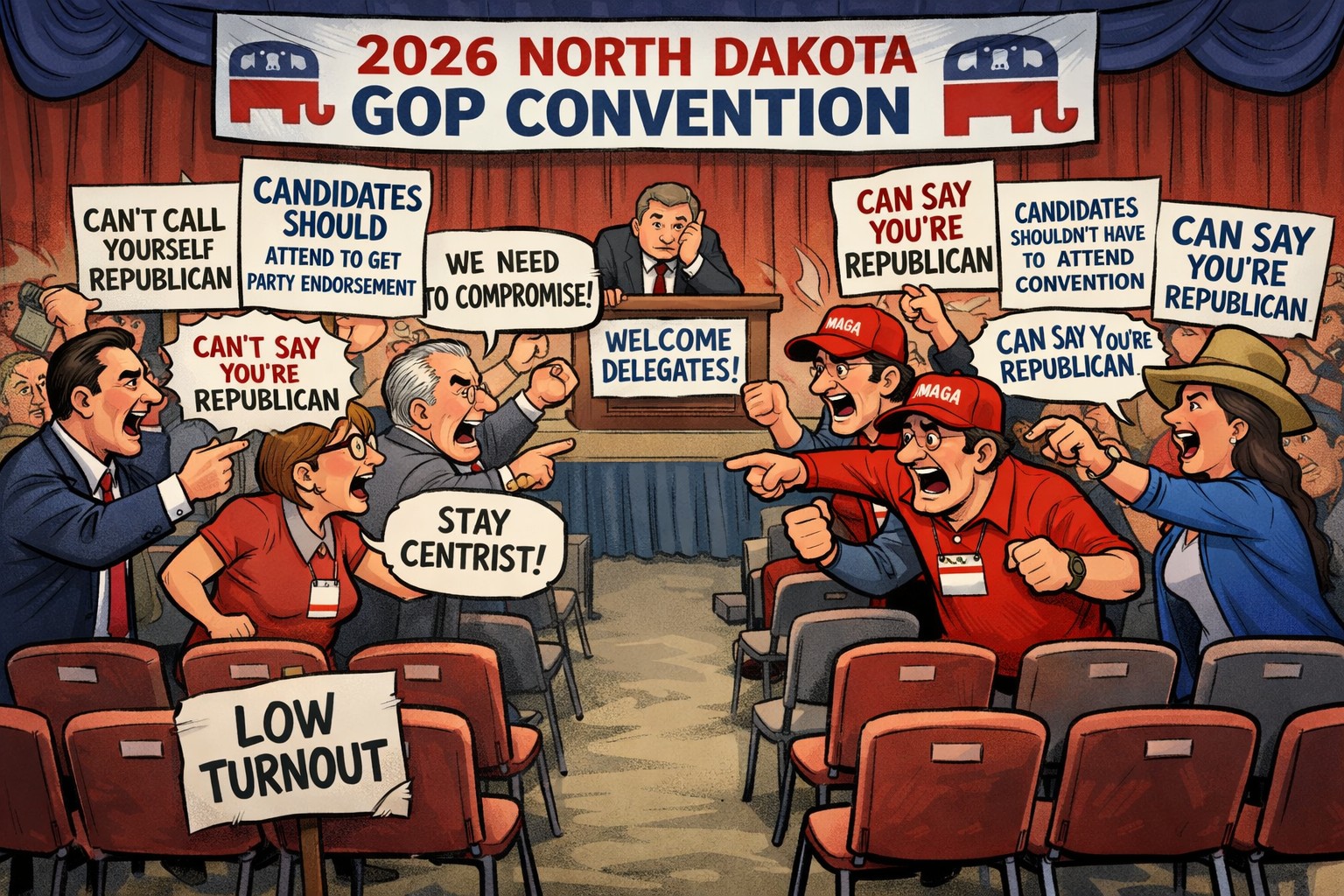
A dramatic and deeply divisive weekend at the North Dakota Republican convention is underscoring a broader political reality: while factions of the state’s Republican party battle over rules, loyalty, and control, the underlying policy record tying them together remains unchanged.
In contrast, Democrats are offering a unified vision with ideas and motivation to help everyday North Dakotans.
Multiple reports, including coverage from KFYR-TV, highlight a GOP convention overshadowed by the absence of nearly every major Republican statewide officeholder — a move political observers describe as unprecedented and emblematic of deep internal divisions. And, with attendance at just 700 people — that means the event has only attracted about half the number of attendees from the prior year.
And, let’s not forget, the mythical “party of family values” convention also kicked off their event with Friday evening speaker Royce White, a U.S. Senate candidate in Minnesota, who is a self-proclaimed anti-semite, misogynist, homophobe, and transphobe according to a history of his Twitter profile. White also was found to have spent hundreds of thousands of dollars in campaign funds from his 2022 U.S. House campaign on a strip club, luxury amenities, and unexplained wire transfers.
A party divided — in public and in practice
Coverage from KFYR-TV shows that tensions at the 2026 North Dakota GOP convention escalated into a direct attempt to reshape who can claim the Republican label.
Delegates narrowly approved a motion aimed at stripping the Republican “brand” from candidates who did not attend the convention — a move widely seen as targeting the incumbent statewide officeholders who chose to skip the event.
The decision, which passed by just six votes after hours of debate, raises serious legal and structural questions: North Dakota law does not require candidates to attend a party convention to run as Republicans. In fact, the state’s system allows candidates to access the ballot either through party endorsement or by collecting signatures and self-identifying with a party, reflecting the state’s open primary structure.
Even party leaders acknowledged the limits of their authority. Convention Chair Matthew Simon noted that any true change to candidate eligibility or party control over ballot labels would require action by the legislature — not a convention vote.
At the center of the divide is a growing rift between more ideologically conservative, MAGA-aligned activists and establishment or incumbent Republicans. That divide has now spilled into open conflict.
Every statewide Republican incumbent up for reelection in 2026 has chosen to bypass the convention entirely, opting instead to appeal directly to voters in the June primary.
Party leadership has openly criticized the decision. North Dakota GOP Chair Matthew Simon said delegates “deserve better,” accusing incumbents of disregarding party activists.
But those incumbents tell a different story — one of dysfunction inside the party itself.
Agriculture Commissioner Doug Goehring pointed to “back-biting and infighting,” while others cited lingering frustration from the chaotic 2024 convention process, where disputes and walkouts undermined confidence in the system.
The result: two competing Republican tracks — convention loyalists seeking ideological purity, and incumbents attempting to sidestep what they view as a broken process.
But North Dakotans should stay alert: Whether it’s the MAGA-controlled makeup of the NDGOP or those who are trying to avoid that label and are skipping the convention, neither of the groups has been friendly with policies to everyday North Dakotans: 1) The NDGOP faction is fixated on culture war issues – arresting librarians and legislating people’s private gender matters – issues that are merely intended to keep North Dakotans distracted so they can avoid addressing real challenges everyday North Dakotans are facing; 2) And then there is the other GOP faction, like Gov. Kelly Armstrong (R) who is pushing for a complete elimination of property tax – including wealthy individuals and corporations who can easily afford it – would push the loss of that tax income to be a burden on the state’s citizens in other ways; US Rep. Fedorchak (R) voted for the Big Beautiful Bill, which delivered permanent tax breaks to billionaires while it weakened rural hospitals and a social safety net for the needy; Attorney General Drew Wrigley (R) has increased taxpayer spending by pursuing “sure to lose” idealogical lawsuits and by dragging his feet on the Ray Holmberg investigation; and Agriculture Commissioner Doug Geohring (R) failed to disclose an energy investment on his financial disclosure form and has a history of misogyny against his female staff.
Skipping the convention — but not the consequences
The move comes as nearly every major Republican statewide officeholder — including Attorney General Drew Wrigley, Secretary of State Michael Howe, Agriculture Commissioner Doug Goehring, and Tax Commissioner Brian Kroshus — bypassed the convention altogether.
Their absence is unprecedented. Longtime party figures say they have never seen a cycle where all incumbents skipped the endorsement process, instead choosing to go directly to voters in the June primary.
While some Republicans frame the decision to skip the convention as a pragmatic move, critics argue it does not absolve those candidates of policy decisions that have shaped North Dakota in recent years.
The Republican Party holds a firm grip on state government, controlling the governorship and maintaining supermajorities in the legislature.
That dominance means both factions — those attending the convention and those avoiding it — share responsibility for the state’s policy direction.
Recent legislative cycles have included:
- Contentious debates over education policy and culture-war legislation
- Ongoing concerns about workforce shortages and economic diversification
- Scrutiny over how state leadership has handled federal funding, taxation, and rural infrastructure needs
Even as Republicans argue internally over process and ideology, those broader policy outcomes remain unchanged — and attributable to the same governing party.
In other words, the divide may be political, but the record is shared.
A contrast in tone from Democrats
While Republicans spar publicly, leaders within the North Dakota Democratic–Nonpartisan League (Dem-NPL) are emphasizing unity.
The party has maintained a cohesive leadership team and consistent messaging heading into the 2026 election cycle.
Rather than engaging in public infighting, Democratic-NPL officials have focused on:
- Recruiting quality candidates for each of the legislative districts
- Addressing economic and rural policy issues
- Putting the needs of everyday North Dakotans at the forefront
- Highlighting the Republican Party’s consistent stream of ethical and legal breaches
- Positioning themselves as fixing an unhealthy imbalance of a single ruling party
The contrast is not lost on political observers: the Republican Party is debating who qualifies as a “real” member while the Democratic Party is presenting a cohesive governing vision ready to listen and lead for the betterment of everyday North Dakotans.
Political theater vs. governing reality
The Minot convention ultimately highlights a broader tension within North Dakota politics: a dominant party struggling with its own identity.
Meanwhile, as Republicans debate endorsements, rules, and internal legitimacy, Democrats are reframing the conversation — from party loyalty to governing results.