



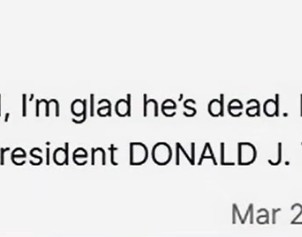
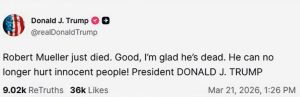
With Donald Trump’s recent posting of the celebration of the death of Robert Mueller – a graduate of Princeton, a Bronze Star and Purple Heart recipient as a US Marine during the Vietnam War, a lawyer, and former director of the FBI – it’s yet another despicable and disgraceful act by Trump where North Dakota’s delegation of US Rep. Julie Fedorchak (R), US Sen. Kevin Cramer (R), and US Sen. John Hoeven (R) remain silent.
This a good time to revisit the Mueller Report: As you’ll read, the investigation did not hurt innocent people, it exposed those who were coordinating with Russian operatives to undermine our election and, in the process, committing crimes to do so.
The Mueller Report: Two Years, 34 Indictments, and a President Left Unexonerated
By Staff Correspondent
On May 17, 2017, the United States Department of Justice took an extraordinary step that would consume the nation’s political attention for nearly 2 years. Deputy Attorney General Rod Rosenstein appointed Robert Mueller as Special Counsel with the mandate to oversee the previously confirmed FBI investigation of Russian government efforts to influence the 2016 presidential election and related matters. The appointment was necessitated by a cascade of events: Attorney General Jeff Sessions had recused himself from investigations into the Trump campaign, and eight days after President Trump fired FBI Director James Comey, Rosenstein appointed Mueller to take over and expand an existing counterintelligence investigation into possible Russian interference in the 2016 election, as well as the investigation into links between Trump associates and Russian officials that Comey had been leading. Rosenstein stated that his decision was “not a finding that crimes have been committed or that any prosecution is warranted,” but that “based upon the unique circumstances, the public interest requires me to place this investigation under the authority of a person who exercises a degree of independence from the normal chain of command.”
Although Mueller did not conclude the President committed a crime, he also was very careful to point out the investigation “does not exonerate him”.
Not a “Collusion” Investigation
Despite Trump’s repeated “No collusion” mantra at every rally, media event, and other opportunity, the public needs to know that was never part of the investigation. In fact, in the 448 page redacted report, on Page 5, it states the investigation did not focus on “collusion” because collusion “is not a specific offense or theory of liability found in the United States Code, nor is it a term of art in federal criminal law.” What Mueller’s team was actually examining was whether any Americans — including members of the Trump campaign — had criminally conspired or coordinated with Russian interference operations, which would constitute a federal crime.
34 Individuals and Three Companies Indicted
Originally, Trump’s former Attorney General Bill Barr had summarized the report findings from the nearly 450 page document down to 4 pages and, once the full Mueller Report was released – was soundly criticized for misrepresenting the findings of the report. In fact, shortly after Barr released the four-page summary, Mueller wrote a letter to Barr stating that the summary “did not fully capture the context, nature, and substance of this Office’s work and conclusions” and led to “public confusion”.
The investigation produced 37 indictments, seven guilty pleas or convictions, and compelling evidence that the president obstructed justice on multiple occasions. In total, 34 individuals and three companies were indicted by Mueller’s investigators. The charges ranged from election interference and computer hacking to financial fraud, unregistered foreign lobbying, and lying to federal investigators. Here is a breakdown of the key figures:
George Papadopoulos — A former Trump campaign foreign policy adviser, Papadopoulos was arrested in July 2017 and pleaded guilty in October 2017 to making false statements to the FBI.
Paul Manafort — Trump’s former campaign chairman, Manafort faced charges in two separate federal courts on a slew of financial crime charges related largely to his lobbying work in Ukraine. A jury found Manafort guilty on eight of 18 counts in the Eastern District of Virginia. Manafort ended up being sentenced to a combined seven and a half years in prison.
Rick Gates — A longtime Manafort associate and Trump campaign official, Gates was charged in connection with financial crimes, unregistered foreign lobbying, and making false statements to federal prosecutors. Gates pleaded guilty in Washington, D.C., in February 2018 on counts of conspiracy against the United States and lying to federal prosecutors.
Michael Flynn — Trump’s former National Security Adviser, Flynn pleaded guilty to lying to FBI agents about his conversations with the Russian ambassador. Flynn had been paid to attend an event in Moscow in December 2015 and sat beside Vladimir Putin, and he lied to Vice President Mike Pence when he said he had no contacts with Russia.
Michael Cohen — Trump’s personal attorney and long-time fixer, Cohen pleaded guilty to making hush payments to Stormy Daniels and Karen McDougal in violation of campaign finance laws, and was convicted of several unrelated counts of bank and tax fraud. In December 2018, he was sentenced to three years in federal prison. He also separately pleaded guilty to lying to Congress about the Trump Tower Moscow project.
Roger Stone — A veteran Republican political operative and longtime Trump ally, Stone was arrested by the FBI and charged with seven counts, including witness tampering and lying to investigators. His jury trial in November 2019 resulted in a conviction on all counts. He was sentenced to forty months in federal prison in February 2020.
Alex van der Zwaan — This Dutch national became the first person sentenced in Mueller’s investigation after pleading guilty to lying to federal agents about his contacts with Trump campaign deputy chair Rick Gates. He reported to prison in May 2018 and was released the next month.
Richard Pinedo — A California man who played an instrumental role in a Russian troll factory’s online influence campaign during the 2016 election by unwittingly selling bank accounts to Russians.
The Internet Research Agency and 13 Russian nationals — Special Counsel Mueller announced charges against three Russian entities and 13 Russian nationals in connection with Moscow’s interference in the 2016 presidential election. The indictment alleged that the Internet Research Agency, a St. Petersburg-based “troll farm” with ties to the Kremlin, orchestrated an influence operation to tip the election in favor of candidate Donald Trump, with Yevgeny Prigozhin named as the financier of the operation.
12 Russian GRU intelligence officers — Twelve Russian defendants, alleged to be members of the Russian GRU cyber espionage group known as Fancy Bear, were charged in June 2018 with hacking and leaking DNC emails. It is unlikely that any of the Russians will ever face a trial in the United States, but the charges make it harder for them to travel overseas.
Konstantin Kilimnik — A longtime business associate of Manafort and Gates, Kilimnik was charged with witness tampering after Manafort and Kilimnik allegedly tried to contact witnesses to get them to make false statements. Kilimnik is in Russia and will likely remain there rather than face charges.
Prison Time: Who Served and Why
Among all those charged, several American figures actually served or were sentenced to prison time:
Papadopoulos was sentenced to 14 days incarceration, 200 hours of community service, and a $9,500 fine for lying to the FBI. Manafort, convicted of tax fraud, bank fraud, and failure to report foreign bank accounts — all tied to millions of dollars he earned from unregistered lobbying for pro-Russian Ukrainian politicians — was sentenced to a combined seven and a half years in prison. Cohen was sentenced to three years in federal prison for campaign finance violations, bank fraud, tax fraud, and lying to Congress. Stone was sentenced to forty months in federal prison for witness tampering and lying to Congress. Van der Zwaan received 30 days for lying to federal agents.
Trump Was Not Exonerated
Perhaps no aspect of the Mueller Report has been more misrepresented than the question of whether President Trump was cleared of wrongdoing. He was not. The Mueller Report explicitly states that it “does not exonerate” the President and explains that the Office of Special Counsel accepted the Department of Justice policy that a sitting President cannot be indicted.
Mueller stated clearly: “If we had had confidence that the president clearly didn’t commit a crime, we would have said so. We did not, however, make a determination as to whether the president did commit a crime.”
On potential obstruction of justice by Trump, the investigation “does not conclude that the President committed a crime,” but neither does it exonerate him, finding public and private actions “by the President that were capable of exerting undue influence over law enforcement investigations.” The report states that Congress can decide whether Trump obstructed justice and has the authority to take action against him.
Mueller pointed to a Justice Department policy — an internal agency opinion from 1973, not a law or a court ruling — that a sitting president cannot be indicted, and noted that the report was conducted as a “thorough, factual investigation in order to preserve the evidence when memories were fresh,” with the understanding that a president can be indicted after leaving office.
Mueller himself, upon his resignation, summarized the matter with deliberate precision: “The Constitution requires a process other than the criminal justice system to formally accuse a sitting president of wrongdoing.” That process, he made clear, belonged to Congress.
Through two years of investigation, the indictment of 34 individuals, and a 448-page final report, Robert Mueller made one thing unambiguously clear: Russia attempted to interfere with the 2016 election. That conclusion, he said, “deserves the attention of every American.”