



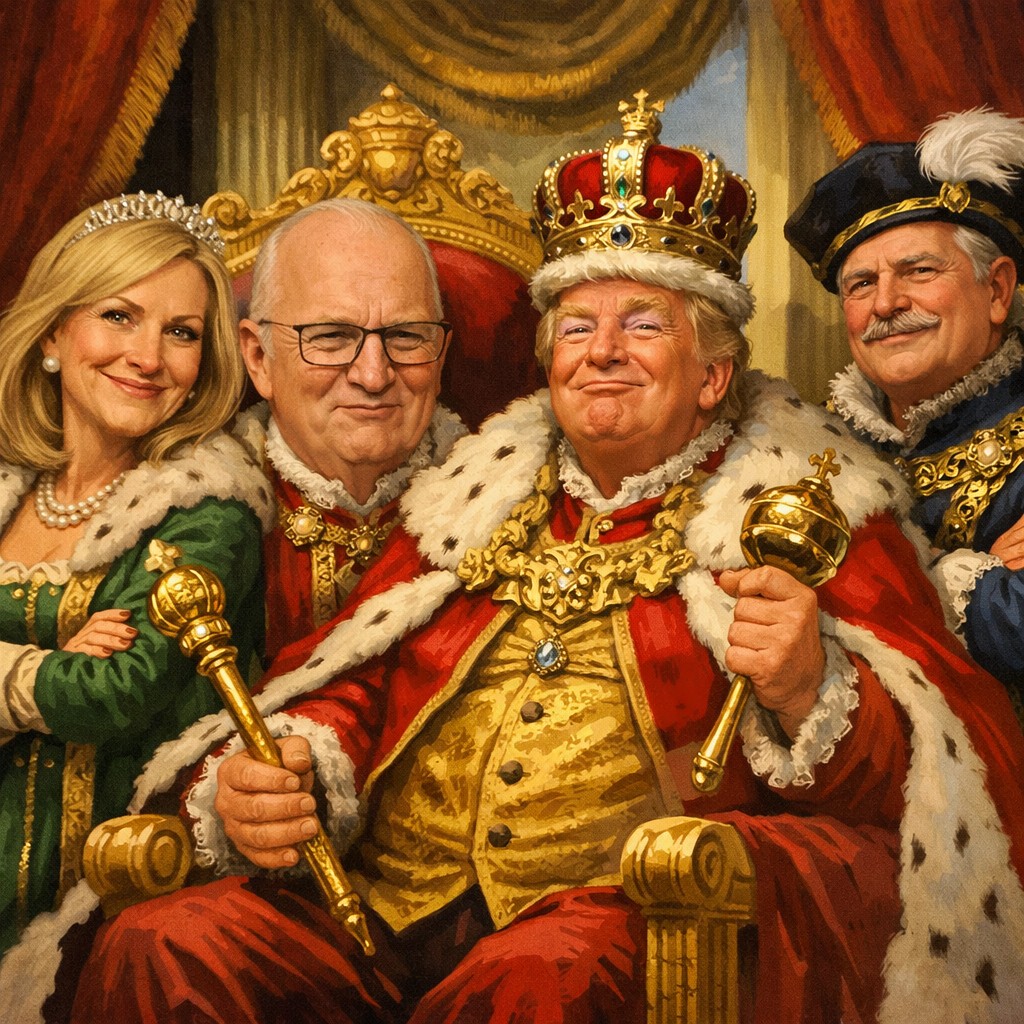
The Gilded Mirror: How America’s Original Age of Excess Has Returned to Haunt Itself
A century after robber barons were tamed by the trust-busters and progressive reformers, the forces that built their empires walk freely among us again — only now they carry smartphones instead of top hats.
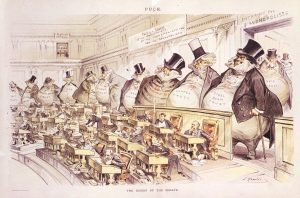
Part I — The First Gilded Age: Sorry, You’re One of the Poors
The year is 1889. Andrew Carnegie has just published his famous essay, “The Gospel of Wealth,” arguing that the rich have a divine obligation to spend their fortunes for the public good — a convenient theology for a man whose steel mills pay workers twelve hours a day, seven days a week, for wages no family could live on with dignity.
Carnegie, John D. Rockefeller, J.P. Morgan, Cornelius Vanderbilt. Their names are carved in library facades and university gates across America, monuments to what the novelist Mark Twain called — with acid precision — the Gilded Age. A thin layer of gold leaf over something far more corroded.
From roughly 1870 to 1900, the United States underwent an economic transformation unmatched in human history. Railroads stitched the continent together. Steel furnaces lit the night sky over Pittsburgh. Oil refineries turned Pennsylvania rock into liquid gold. And atop this furious machinery of production sat a vanishingly small number of men who accumulated fortunes that defied comprehension.
By 1890, the wealthiest one percent of American families controlled more than half the nation’s total wealth. The richest 0.01 percent held more than the bottom ninety percent combined. Rockefeller’s Standard Oil, at its peak, controlled ninety percent of America’s oil refining capacity — a monopoly so complete it could set prices not just for consumers, but for the railroads that moved its product, through a system of secret rebates that effectively made competition impossible.
This was not mere success. This was systemic domination. These men did not simply earn more than others; they structured the economy itself so that earning less was often the only option available to everyone beneath them. Company towns paid workers in scrip redeemable only at company stores. Labor organizers were met with Pinkerton detectives and, when necessary, federal troops. The legal system, staffed by judges who had often worked for the very railroads and banks now before them, reliably sided with capital over labor.
Congress was not so much corrupted by these men as it was operated by them. The Republican Party, dominant in the Gilded Age, was funded by industrial interests and reliably produced tariffs that protected domestic monopolies, land grants that enriched railroad barons, and a gold standard that transferred wealth upward by keeping money scarce and credit expensive for farmers and workers.
Senator Nelson Aldrich of Rhode Island, the most powerful legislator of the era, was the father-in-law of John D. Rockefeller Jr. He did not recuse himself from legislation affecting oil or banking. The concept barely existed.
The human cost was staggering. In 1890s New York, Jacob Riis documented the slums of the Lower East Side — families of ten in single rooms, children working in garment factories by age seven, tuberculosis moving through tenements like a slow fire. In Chicago’s meatpacking district, the conditions Upton Sinclair described in The Jungle were not fiction but journalism dressed as a novel. Workers fell into rendering vats. Rat poison and rat droppings mixed indistinguishably with the product bound for American dinner tables.
The inequality of the Gilded Age was not merely economic. It expressed itself in every dimension of life: in health, in safety, in education, in political access. If you were born into the laboring class in 1880, your chances of crossing into the professional or owning class were statistically negligible. The myth of American mobility was already a myth.
Senator Robert La Follette of Wisconsin captured the moment with characteristic bluntness in 1912: he wrote that there was not a man among the reformers who did not sometimes wonder whether the nation had a future, or whether the people would ever really rule. He was not speaking metaphorically. He meant it literally: the democratic machinery of the republic had been captured.
And yet — this is the part the story rarely reaches — it ended. Not easily, not quickly, not without a generation of furious political warfare. But it ended. The forces that had seemed permanently entrenched were, over the course of roughly forty years, substantially broken and reformed.
Part II — How Congress Dismantled the Machine
The counterattack against Gilded Age inequality did not arrive as a single decisive blow. It came in waves, each one washing a little further up the beach, each one the product of specific political conditions, specific personalities, and specific crises that made reform suddenly possible.
The Sherman Antitrust Act of 1890 was the first major shot. It passed nearly unanimously — not because Congress had developed a sudden conscience, but because monopoly had become so visibly destructive that even the men who had funded the monopolies were embarrassed. But for a decade the law sat largely unenforced, its language broad enough to be used against labor unions as readily as against corporations.
Theodore Roosevelt changed that. Ascending to the presidency in 1901 after William McKinley’s assassination, Roosevelt was not a radical. He was a patrician who feared that unrestrained plutocracy would produce the very revolution it was designed to prevent. He sued Standard Oil. He dissolved the Northern Securities railroad trust. He pushed through the Pure Food and Drug Act and the Meat Inspection Act after Sinclair’s novel turned the public’s stomach — literally — against industrial food production. He coined the term “muckraker” as a mild insult for investigative journalists, then found himself doing exactly what they demanded.
The Sixteenth Amendment to the Constitution, ratified in 1913, authorized the federal income tax. The Revenue Act of that same year imposed a modest one percent tax on the wealthiest Americans — a foot in the door, nothing more. But the architecture was in place. Over the next three decades, rates climbed steeply and deliberately. By 1944, the top marginal rate reached 91 percent on income above $200,000, the equivalent of roughly $3.5 million in today’s dollars. This was not punitive fantasy. It was the explicit, broadly popular policy of a federal government that had decided concentrated private wealth was a threat to democratic governance.
The New Deal of the 1930s completed what the Progressive Era had begun. Franklin Roosevelt, facing an economy that had collapsed spectacularly under the weight of its own inequalities, passed a body of legislation that fundamentally reshaped the relationship between capital, labor, and the state. The Wagner Act of 1935 guaranteed workers the right to unionize and required employers to bargain in good faith. Social Security created a floor beneath which the old and the destitute could not fall. The Securities Exchange Act brought the stock market under federal oversight. The Glass-Steagall Act separated commercial banking from the speculative casino of investment banking — a firewall that held for sixty years until it was repealed in 1999.
Roosevelt reportedly told associates in private that they had to save capitalism from the capitalists. Whether precisely apocryphal or not, it captures something true: the reformers of the Progressive Era and New Deal were not socialists. They were, in the main, people who believed that a market economy was worth preserving — and that preserving it required breaking its most destructive concentrations of power.
The effect on inequality was dramatic and measurable. Between 1940 and 1970, the share of income going to the top one percent of Americans fell by more than half. Union membership, which had been negligible in the Gilded Age, peaked at around 35 percent of the American workforce by the mid-1950s. Real wages for working Americans roughly doubled between 1948 and 1973. The postwar decades — the much-celebrated era of middle-class prosperity — were not some spontaneous flourishing of the free market. They were the product of deliberate political choices to redistribute economic power downward. When people speak nostalgically of the America that once was, they are describing, whether they know it or not, the America that progressive reform built.
Part III — The New Gilded Age
The dismantling of New Deal-era constraints began quietly in the 1970s and accelerated through the 1980s. The deregulation of financial markets. The breaking of the air traffic controllers’ union by Ronald Reagan in 1981 — a signal to employers everywhere that the federal government would no longer stand behind organized labor. The steady reduction of top marginal tax rates from 91 percent in 1963 to 70 percent in 1981 to 28 percent by 1988. Each change was, taken alone, incremental and debatable. Cumulatively, they were revolutionary.
By 2024, the share of American wealth held by the top one percent had climbed back above 30 percent — higher than at any point since the original Gilded Age. The three wealthiest Americans — Elon Musk, Jeff Bezos, and Mark Zuckerberg — held between them more wealth than the bottom half of the American population combined: approximately 165 million people. This is not a rhetorical flourish. It is a census of the distance that has opened up.
The monopoly problem has returned in digital form, and the parallels to the original Gilded Age are structural rather than merely rhetorical. Standard Oil once controlled ninety percent of American oil refining. Google today processes approximately ninety percent of American internet searches — a number that a federal judge in 2024 ruled the company had illegally maintained through exclusive default agreements with device manufacturers, the digital equivalent of Rockefeller’s railroad rebates. Meta owns not just Facebook but Instagram and WhatsApp — the three dominant social communication platforms — purchased in acquisitions that regulators at the time waved through without serious scrutiny. Amazon controls an estimated forty percent of American e-commerce and provides cloud computing infrastructure to a significant fraction of the global internet, while simultaneously using data from third-party sellers on its platform to develop competing products. Apple and Google together control the duopoly through which the world’s smartphone apps must pass, each taking a thirty percent commission that developers have no practical option to avoid.
These companies are Standard Oil with servers. The mechanism of dominance is different — network effects rather than railroad rebates, algorithmic lock-in rather than physical monopoly — but the economic logic is identical. Once you control the pipeline, you can set the price for everyone who needs to move goods through it. Rockefeller would have recognized the playbook immediately, and admired its elegance.
The political capture that characterized the original Gilded Age has also returned, in constitutionally protected form. The Supreme Court’s 2010 Citizens United decision — which held that corporations have a First Amendment right to spend unlimited money on political speech — opened a floodgate that has transformed American politics. In the 2024 election cycle, outside spending on federal elections exceeded $4 billion, with a substantial fraction flowing from a very small number of extraordinarily wealthy donors. Dark money organizations, structured to conceal their funders, spent hundreds of millions more.
Elon Musk, who donated over $250 million to Republican causes in the 2024 election cycle and was subsequently appointed to lead a government efficiency initiative with broad executive authority to restructure federal agencies, represents something Gilded Age observers would have found entirely familiar: a man who made his fortune substantially through government contracts and favorable regulation — Tesla’s tax credits, SpaceX’s NASA contracts, Starlink’s defense agreements — who then used that fortune to purchase influence over the very government that had enriched him. Senator Aldrich and John D. Rockefeller Jr. would have understood the arrangement completely.
The labor conditions of the new Gilded Age wear a different costume but reveal the same skeleton. The original era had the company town and the twelve-hour shift. Today it has the gig economy — a legal architecture carefully constructed to deny workers the employment status that would entitle them to minimum wage protections, overtime pay, unemployment insurance, workers’ compensation, and the right to organize.
Uber, Lyft, DoorDash, and Amazon’s delivery network have built multi-billion-dollar enterprises substantially on the backs of workers classified as independent contractors rather than employees. When California voters passed Proposition 22 in 2020 — enshrining this classification into state law — it followed a $220 million spending campaign by the gig companies themselves: the most expensive ballot initiative in California history. The workers whose status was being decided had no comparable resources to contest it. The Pinkertons of the twenty-first century carry briefcases and engage political consultants.
Amazon warehouse workers face productivity quotas so demanding that, according to internal data obtained by investigative journalists, injury rates at Amazon fulfillment centers run substantially higher than the industry average for comparable warehouse work. Workers have described being afraid to take bathroom breaks for fear of missing their pick-rate targets — an algorithmic management system that mirrors, in digital form, the time-motion studies that Frederick Winslow Taylor designed in the 1890s to extract maximum productivity from factory workers. The company disputes these characterizations vigorously. The injury data, which Amazon is required to file with federal regulators, does not.
Part IV — The Question Before Us
Mark Twain is often credited with saying that history doesn’t repeat itself, but it often rhymes. The rhyme we are living through is unmistakable. The specific instruments have changed. The railroads are now fiber optic cables. The oil wells are now data centers. The trust lawyers now write terms of service instead of shipping contracts. The scrip is now app store currency and gig-platform credit. But the fundamental pattern — a small group of people using control of critical infrastructure to extract extraordinary wealth from everyone who depends on that infrastructure, and then using that wealth to influence the political system that might otherwise restrain them — is the same pattern Twain’s America was living through when he gave it its name.
The reformers of the Progressive Era had several things that reformers today struggle to assemble. They had a public primed by decades of muckraking journalism — Ida Tarbell’s nineteen-part exposé of Standard Oil in McClure’s Magazine, Lincoln Steffens’ documentation of municipal corruption, Sinclair’s The Jungle — which created genuine mass outrage capable of sustaining legislative pressure over years. They had politicians, most notably Roosevelt and later Wilson and Franklin Roosevelt, who understood that the legitimacy of the entire capitalist system depended on its appearing, at minimum, to operate in the public interest. And they had an intellectual framework, developed by economists and lawyers over decades, for understanding monopoly as a structural problem requiring structural solutions.
Today, the antitrust movement is experiencing a genuine revival — late, partial, but real. The Federal Trade Commission under Lina Khan pursued an aggressive enforcement agenda grounded in exactly this kind of structural analysis before her departure from the commission in early 2025. The DOJ’s case against Google’s search monopoly produced a landmark 2024 ruling finding illegal maintenance of monopoly power — the most significant antitrust decision in a generation. Senator Amy Klobuchar’s American Innovation and Choice Online Act, which would have prohibited dominant platforms from preferencing their own products, drew serious bipartisan support before stalling.
But these developments exist alongside deeply discouraging ones. The incoming Trump administration in 2025 moved to dismantle regulatory enforcement across multiple domains. The Consumer Financial Protection Bureau, created after the 2008 financial crisis precisely because deregulation had produced catastrophic results, was effectively defunded through executive action before courts intervened. Antitrust enforcement at the FTC was curtailed. The administration’s posture toward Big Tech merger review softened noticeably in the early months of 2025.
La Follette’s question from 1912 — whether the nation has a future, or whether the people will ever really rule — has aged poorly only in its unfamiliarity. The question itself is as urgent as it has ever been. The first Gilded Age ended not because the powerful voluntarily relinquished their advantages, but because the democratic machinery of the republic — creaking, corrupted in places, but not yet broken — was seized by citizens who understood what was at stake and refused to yield it back. That process took decades, required specific people making specific political choices under enormous pressure, and produced results that were imperfect but real and lasting.
The history is neither comforting nor discouraging in any simple sense. It is a record of what has been done before, which is the most reliable evidence available that it can be done again. Whether it will be is a different question entirely — one that belongs not to historians, but to the living.